
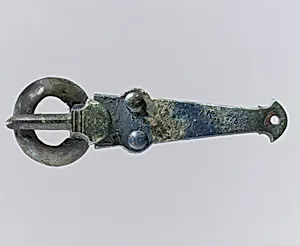
Elongated Buckle
Unknown Artist
7th century (?)
Medium
Copper alloy
Dimensions
Overall: 3 11/16 x 1 3/16 x 1/2 in. (9.3 x 3 x 1.3 cm)
Classification
Metalwork-Copper
Culture
Langobardic or Frankish
Department
Medieval Art
Museum
Metropolitan Museum of Art, New York, NY
Credit
Gift of J. Pierpont Morgan, 1917
Accession Number
17.193.171a
Rights
Public Domain
Art Historical Context
Step into the world of early medieval craftsmanship with the *Elongated Buckle a delicate copper alloy artifact from the 7th century (circa). Measuring just 3 11/16 x 1 3/16 x 1/2 inches, this small yet intricate piece was likely part of a belt or strap, blending everyday utility with flair. Crafted by an unknown artist, its slender, elongated form exemplifies the precision of metalworking techniques in copper alloy—a durable, accessible material that allowed for fine detailing and corrosion resistance, making it ideal for personal adornments. Housed in the Metropolitan Museum of Art's Medieval Art department and attributed to either Langobardic or Frankish culture, the buckle reflects the dynamic cultural exchanges of post-Roman Europe. The Langobards (Lombards), who ruled much of Italy after their 6th-century invasions, and the Franks, expanding across Gaul, produced such metalwork as symbols of status and identity. These buckles often featured in burials or hoards, hinting at their role in daily life and ritual. Donated by J. Pierpont Morgan in 1917, it offers a tangible link to a transformative era when barbarian kingdoms laid the foundations of medieval Europe. This unassuming treasure invites us to ponder the skilled hands behind it—artisans who transformed humble metal into enduring legacy.