
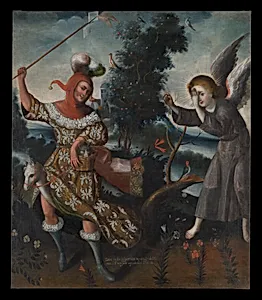
Emblem of Folly
18th Century
Medium
Oil on canvas
Dimensions
49 5/8 × 43 5/16 in. (126 × 110 cm)
Classification
Painting
Culture
Peru (Cuzco)
Department
The American Wing
Museum
Metropolitan Museum of Art, New York, NY
Credit
Gift of Clifford Ming Teh Li, in honor of James Kung Wei Li and Julie Chu Lu Li, 2018
Accession Number
2018.836.1
Rights
Public Domain
Art Historical Context
"Emblem of Folly" is an evocative 18th-century oil on canvas created in Cuzco, Peru, during the height of the colonial period. The title suggests an allegorical theme common to Baroque-era emblem books, likely illustrating the moral consequences of unwise behavior through symbolic figures or scenes. Produced in the renowned Cuzco school, the painting reflects the fusion of European artistic traditions with local Andean craftsmanship, as indigenous and mestizo artists adapted imported prints and ideas to suit regional tastes and devotional needs. Although the painter remains unknown, the work may draw inspiration from Flemish engraver Boetius Adams Bolswert, whose designs circulated widely in the Americas. Executed in oil on canvas—a medium favored for its durability and rich color—the piece measures just over four feet tall, making it suitable for private chapels or elite homes. Its presence in the Metropolitan Museum’s American Wing highlights the broader story of cultural exchange across the hemisphere. This recent gift enriches our understanding of colonial Latin American art as both a vehicle for moral instruction and a vibrant expression of hybrid identity.