
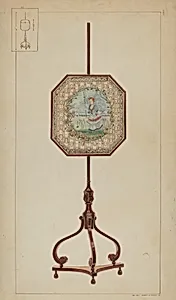
Embroidered Fire Screen
c. 1937
Medium
watercolor, colored pencil, pen and ink, and graphite on paper
Dimensions
overall: 45.2 x 26.7 cm (17 13/16 x 10 1/2 in.) Original IAD Object: 61 1/2"high overall; 17 1/2 x 16"screen; 14"spread of legs.
Classification
Index of American Design
Department
CG-W
Museum
National Gallery of Art, Washington, D.C.
Credit
Index of American Design
Accession Number
1943.8.5248
Rights
Public Domain
Art Historical Context
Behold the *Embroidered Fire Screen a meticulous rendering by Ernest A. Towers,., created around 1937. This vibrant watercolor, colored pencil, pen and, and graphite drawing on paper (45.2 x 26.7 cm) captures intricate details of a functional yet ornamental American household object. Fire screens like this one, standing about 61½ inches high with a 17½ x 16-inch screen and 14-inch leg spread, were popular in the 19th century to shield delicate complexions from fireplace heat and sparks while adding elegance to parlors. As part of the Index of American Design—a groundbreaking WPA Federal Art Project from the Great Depression era—this artwork exemplifies the program's mission to document and celebrate everyday American folk art and craftsmanship. Artists like Towers produced over 15,000 precise, colorful studies of regional designs, preserving cultural heritage amid economic hardship. His skilled layering of media brings the embroidery's floral motifs and delicate stitching to life, highlighting techniques rooted in domestic needlework traditions. Displayed at the National Gallery of Art, this piece invites us to appreciate how ordinary objects embodied artistic ingenuity and national pride, bridging past and present in a single, vivid frame.
About the Artist
Ernest A. Towers, Jr.
Ernest A. Towers, Jr. was an American artist active during the late 1930s and early 1940s, best known for his meticulous contributions to the Index of American Design, a Federal Art Project under the Works Progress Administration (WPA). This ambitious initiative commissioned artists across the United States to create watercolor renderings of everyday American folk art, crafts, and decorative objec...