
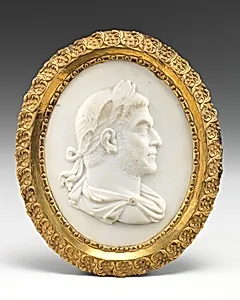
Emperor Marcus Julius Philippus
18th century
Medium
White jasperware
Dimensions
2 × 1 5/8 in. (5.1 × 4.1 cm)
Classification
Ceramics-Pottery
Culture
British, Staffordshire
Department
European Sculpture and Decorative Arts
Museum
Metropolitan Museum of Art, New York, NY
Credit
Bequest of Mary Clark Thompson, 1923
Accession Number
24.80.45
Rights
Public Domain
Tags
Art Historical Context
This delicate white jasperware medallion portrays Emperor Marcus Julius Philippus, known as Philip the Arab, a Roman ruler of the 3rd century CE, in a classic profile view. Produced by the esteemed British partnership of Josiah Wedgwood and Thomas Bentley in 18th-century Staffordshire, it measures a petite 2 × 1⅝ inches (5.1 × 4.1 cm), ideal for display in a collector's cabinet or as a neoclassical ornament. Wedgwood's revolutionary jasperware technique—a fine, unglazed stoneware with a matte white body—recreated the elegance of ancient Greek and Roman cameos. Applied reliefs in contrasting colors captured intricate details, making these ceramics highly prized during the Enlightenment's classical revival. This piece exemplifies Staffordshire pottery's global influence, blending artistry with industrial innovation. Housed in the Metropolitan Museum of Art's Department of European Sculpture and Decorative Arts (bequest of Mary Clark Thompson, 1923), it reflects 18th-century Britain's fascination with imperial Roman history, turning emperors into accessible icons of refined taste. A testament to enduring craftsmanship, it invites visitors to appreciate the bridge between antiquity and the modern age.