
Emperor Maximilian I
1520
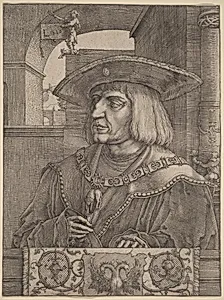
Medium
engraving and etching
Dimensions
sheet (trimmed to plate mark): 26.3 x 19.6 cm (10 3/8 x 7 11/16 in.)
Classification
Department
CG-E
Museum
National Gallery of Art, Washington, D.C.
Credit
Rosenwald Collection
Accession Number
1943.3.5638
Rights
Public Domain
Art Historical Context
Behold the striking portrait *Emperor Maximilian I (1520), a masterful engraving and etching by van Leyden, one the Northern Renaissance's finest Dutch printmakers. Created just a year after the Holy Roman Emperor's death in 9, this intimate sheet—trimmed to its precise plate mark of 26.3 x 19.6 cm—captures Maximilian's regal presence, likely in armor, evoking his legacy as a powerful patron of the arts and ambitious ruler who bridged the late medieval and Renaissance eras. Van Leyden, prodigy influenced by Albrecht Dürer, excelled in the meticulous line work of engraving, where metal plates are incised with burins for sharp, controlled details. His innovative use of etching—applying acid to bitten lines—added softer tones and textures, perfect for conveying the sheen of armor and intricate backgrounds in this compact format. Prints like this were revolutionary, enabling affordable reproduction and wide dissemination of elite imagery. Housed in the National Gallery of Art's Rosenwald Collection (Department CG-E), this work exemplifies how 16th-century prints democratized portraiture, immortalizing emperors for scholars, collectors, and the public alike. A testament to technical virtuosity and historical reverence!
About the Artist
Lucas van Leyden · 1484–1533
Lucas van Leyden (1494–1533) was a Dutch painter and printmaker who stands among the greatest engravers of the Northern Renaissance. Born in Leiden as either Lucas Hugensz or Lucas Jacobsz, he lived and worked primarily in his native city, achieving international renown that rivaled the German master Albrecht Dürer. Lucas van Leyden revolutionized Netherlandish printmaking and was among the first...