
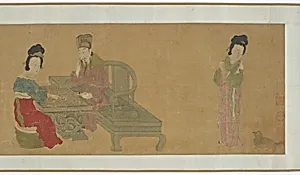
Emperor Minghuang and Consort Yang Playing Weiqi
Classification
Painting
Department
Smithsonian Collection
Museum
Smithsonian American Art Museum
Credit
Gift of Charles Lang Freer
Accession Number
F1911.227
Rights
Public Domain
Tags
About this artwork
To 1911
Art Historical Context
This enchanting painting captures a tender moment between Emperor Xuanzong, known as Minghuang (r. 712–756 CE), and his beloved consort Guifei, immersed in a game of weiqi (also called Go), China's ancient strategic board game dating back over 2,500 years. The dynasty (618–907 CE) lovers are legendary figures in Chinese history and literature, their romance immortalized in poetry and drama for its passion and eventual tragedy amid the An Lushan Rebellion. Depicting them in quiet play humanizes these imperial icons, highlighting themes of leisure, intellect, and intimacy amid courtly life. Formerly attributed to the Yuan dynasty artist Qian Xuan (ca. 1235–before 1307), a master of orthodox Song-style painting who revived classical Chinese techniques, this work likely dates to the 17th century during the Ming (1368–1644) or early Qing (1644–1911) dynasties. Such attributions reflect the era's reverence for Tang-era subjects, often recreated in ink and color on silk or paper to evoke poetic nostalgia. The precise medium is unknown, but its style underscores the enduring appeal of literati painting traditions. A gem from the Charles Lang Freer collection, gifted to the Smithsonian American Art Museum, this piece bridges China's imperial past with modern appreciation, inviting visitors to ponder the timeless blend of strategy, romance, and artistry in Chinese culture.