
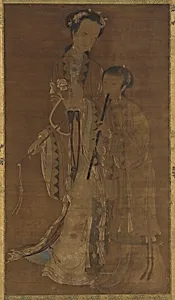
Courtesans with fan and flute
17th-18th century
Classification
Painting
Department
Smithsonian Collection
Museum
Smithsonian American Art Museum
Credit
Gift of Charles Lang Freer
Accession Number
F1916.107
Rights
Public Domain
Tags
About this artwork
In the In the Ming (1368-1644) and Qing (1644-1911) dynasties, visits to urban pleasure quarters were a regular occurrence in upper-class life. For educated men, an interlude with a courtesan was a time to shake off official duties and Confucian responsibilities, and they enjoyed being entertained by witty and artistically talented women who played chess, wrote poetry, danced, and knew music. This painting of a young woman who suggestively holds a flute is charged with sexual innuendo. Her compa...
Art Historical Context
In the Ming (1368–1644) and Qing (1644–1911) dyn, China's urban pleasure quarters offered elite men a respite from Confucian duties and official life. Educated gentlemen frequented these spaces to enjoy the company of courtesans—itty, multifaceted women skilled in poetry, chess, dance, and music. *Courtesans with Fan and Flute*, a 17th–18th-century Chinese painting from the Qing era, captures this vibrant cultural scene, evoking the blend of artistry and sensuality that defined such encounters. The composition features two women: a youthful courtesan suggestively holding a flute, a motif rich with sexual innuendo in Chinese art, and her more senior companion grasping a rose—a gesture commonly linked to erotic themes. These symbols highlight the playful yet charged intimacy of the pleasure quarters, where entertainment often carried deeper, seductive undertones. Though formerly attributed to the 12th-century artist Zhang Gui, the work reflects later Qing traditions in painting, emphasizing elegance and subtle eroticism. A gift from collector Charles Lang Freer, this piece now graces the Smithsonian American Art Museum, offering a window into China's sophisticated social world and the enduring allure of its courtesan culture.