
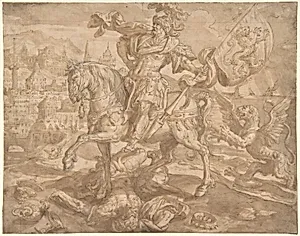
Emperor Ninus
mid-16th–early 17th century
Medium
Black chalk, pen and brown ink, brown wash
Dimensions
sheet: 8 1/8 x 10 1/4 in. (20.6 x 26 cm)
Classification
Drawings
Department
Drawings and Prints
Museum
Metropolitan Museum of Art, New York, NY
Credit
Anonymous Gift, 2005
Accession Number
2005.418.27
Rights
Public Domain
Tags
Art Historical Context
"Emperor Ninus," a captivating drawing by Flemish artist Maerten de Vos (1532–1603), dates to the mid-16th to early 17th century. Created with black chalk, pen and brown ink, and brown wash on a modest sheet measuring 8 1/8 x 10 1/4 inches, this work exemplifies the preparatory sketches that were vital in de Vos's Antwerp workshop. As a leading figure in Northern Mannerism, de Vos blended Italianate elegance with Flemish detail, producing thousands of drawings for paintings, tapestries, and prints. Housed in the Metropolitan Museum of Art's Drawings and Prints department, it entered the collection via an anonymous gift in 2005. The composition likely centers on the legendary Assyrian ruler Ninus, founder of Nineveh, amid a dynamic scene featuring men, horses, and fluttering flags—evoking a procession, battle, or imperial triumph drawn from classical histories. De Vos's masterful use of brown wash adds depth and drama, with fluid pen lines capturing movement and texture, a technique honed during the Renaissance for modeling forms realistically yet expressively. This drawing highlights the era's fascination with ancient heroes, bridging classical mythology and Counter-Reformation humanism in the Netherlands. It offers visitors a window into de Vos's versatile draftsmanship, where everyday sketches fueled grand artistic enterprises.