
Empress Eugénia
1860–69
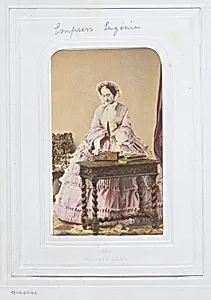
Medium
Albumen print
Dimensions
Image/paper: 8.6 × 5.2 cm (3 7/16 × 2 1/16 in.); Mount: 10.4 × 6.2 cm (4 1/8 × 2 1/2 in.)
Classification
photograph
Department
Photography and Media
Museum
Art Institute of Chicago
Accession Number
228218
Rights
Public Domain
Art Historical Context
In the glittering era of the Second French Empire André-Adolphe-Eène Disdéri captured the elegance of Empress Eugénie in this intimate albumen print from the 1860s. Eugénie de Montijo, wife of Napoleon III, was fashion icon whose poised portrait exemplifies the opulence and refinement of imperial France. Disdéri, a pioneering French photographer, revolutionized portraiture with his invention of the *carte de visite*—compact photographs like this one (measuring just 8.6 × 5.2 cm)—that became wildly popular calling cards traded among Europe's elite. The albumen printing process, using egg whites to bind light-sensitive silver salts to paper, produced the sharp detail and warm tones that made these images so lifelike and desirable. This medium dominated mid-19th-century photography, enabling mass production and affordability, which democratized portraiture while fueling a collecting craze. Eugénie's serene gaze and elaborate attire reflect not just royal splendor but the era's cultural obsession with celebrity and status. Held in the Art Institute of Chicago's Photography and Media department, this photograph offers a window into how photography bridged art and society, transforming everyday mementos into historical treasures. Visitors, imagine slipping this into your pocket as a token of empire!
About the Artist
André-Adolphe-Eugène Disdéri · 1819–1889
**André-Adolphe-Eugène Disdéri** (1819–1889) was a pioneering French photographer whose innovations transformed portraiture into a mass medium during the Second Empire. Born on March 28, 1819, in Paris, Disdéri pursued diverse careers in commerce, acting, and politics early on, while studying art amid personal hardships following his father's death, which compelled him to support his mother, sibli...