
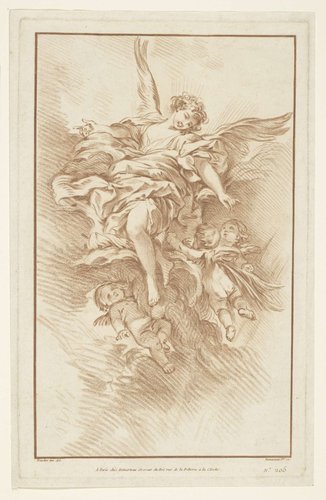
Engel met drie putti in wolken
1732 - 1776
Medium
etching
Dimensions
235; 373
Rights
Public Domain
About this artwork
verzamelaarsmerk, verso, gestempeld: Lugt 975
Art Historical Context
"Engel met drie putti in wolken" (Angel with Three Putti in Clouds) is a delicate etching by Gilles Demarteau, a prominent 18th-century engraver active between 1732 and 1776. Demarteau, working primarily in Paris, was renowned for his reproductive prints that captured the elegance of Rococo painting, often after masters like François Boucher. This work exemplifies his skill in translating soft, ethereal forms into the crisp lines of etching—a technique where acid etches designs into a metal plate, allowing for intricate details and tonal subtlety ideal for heavenly scenes. The composition features a central angel surrounded by three playful putti amid swirling clouds, evoking divine joy and celestial harmony. Common in Baroque and Rococo art, putti symbolize innocence and the divine presence, making this print a charming reflection of 18th-century religious and decorative tastes. Measuring 373 mm high by 235 mm wide, its scale suits intimate collector's cabinets or scholarly study. On the verso, a stamped collector's mark (Lugt 975) hints at its prized status among connoisseurs, linking it to esteemed European collections. As a testament to Demarteau's mastery, this etching bridges fine art and printmaking, offering visitors a glimpse into the luminous world of Enlightenment-era devotion.
About the Artist
Gilles Demarteau · 1729–1776
Gilles Demarteau the Elder, born on January 19, 1722, in Liège, began his career steeped in the craft of metalwork. The son of a gunsmith, he learned engraving and goldsmithing from his father before moving to Paris around 1748–1750 to join his brother, who worked as a goldsmith for the engraver De Lacollombe, renowned for firearm ornament designs. Demarteau trained in De Lacollombe's workshop as ...