
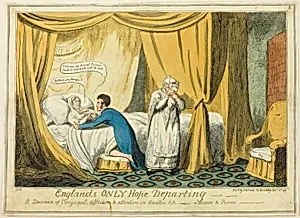
England's Only Hope Departing
published December 2, 1817
Medium
Hand-colored etching on ivory laid paper
Dimensions
Image: 26.5 × 37 cm (10 7/16 × 14 5/8 in.); Sheet cut to platemark: 27.5 × 38 cm (10 7/8 × 15 in.)
Classification
etching
Department
Prints and Drawings
Museum
Art Institute of Chicago
Accession Number
89880
Rights
Public Domain
Art Historical Context
George Cruikshank’s-colored etching *England’s Hope Departing*, published on December 2, 1817, captures the sharp wit of early nineteenth-century British satire. As one of the period’s leading caricaturists, Crushank used the print medium to comment on political and social events, reaching a broad audience through affordable, widely circulated images. The evocative title suggests a moment of national concern, typical of the artist’s ability to blend humor with pointed observation. Created as an etching on ivory laid paper and finished by hand with watercolor, the work exemplifies the lively graphic tradition of Georgian England. Etchings allowed artists to produce detailed, expressive lines quickly, while the addition of color heightened their visual impact and appeal. Measuring roughly 10½ by 14⅝ inches, the print was designed for intimate viewing yet carried messages that resonated far beyond the parlor. Today in the Art Institute of Chicago’s collection of Prints and Drawings, the sheet offers visitors a window into how visual satire shaped public discourse two centuries ago. Its crisp lines and vibrant hues remind us of the enduring power of caricature to reflect the hopes and anxieties of its time.
About the Artist
George Cruikshank · 1792–1878
George Cruikshank (1792–1878) was born in London on 27 September 1792, the son of Scottish caricaturist Isaac Cruikshank and Mary MacNaughton. His older brother, Isaac Robert Cruikshank, was also a caricaturist and illustrator, while his sister Eliza worked as a designer. From a young age, Cruikshank assisted his father in the studio, contributing titles, backgrounds, and lettering to cartoons by ...