
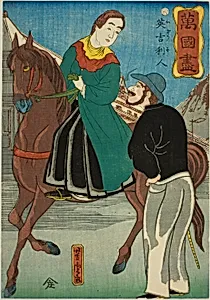
English (Igirisujin), from the series "A Collection of Various Countries (Bankoku zukushi)"
Medium
Color woodblock print; oban
Classification
woodblock print
Department
Arts of Asia
Museum
Art Institute of Chicago
Accession Number
32017
Rights
Public Domain
Art Historical Context
In the vibrant world of 19th-century Japanese ukiyo-e prints, Utagawa Yoshitor captures global curiosity with *English (Igirisuj)* from his series *A Collection of Various Countries (Bankoku zushi)*, created in 1860. This color woodblock print in oban format—measuring about 14 by 10 inches—showcases an Englishman, likely dressed in Western attire, reflecting Japan's growing fascination with foreigners during the final years of the Edo period. Yoshitora, a prolific artist from the Utagawa school, specialized in dynamic scenes of warriors, actors, and exotic subjects. This print belongs to the Yokohama-e genre, which exploded after Commodore Perry's arrival in 1853 forced Japan to end over two centuries of isolation (sakoku). As trade ports like Yokohama opened, artists like Yoshitora documented Europeans with a mix of awe and caricature, blending traditional ukiyo-e techniques—precise woodblock carving and hand-applied colors—with novel details like Victorian clothing and features. Held in the Art Institute of Chicago's Arts of Asia collection, this work highlights a pivotal cultural shift toward globalization, offering visitors a window into how ordinary Japanese people imagined the "barbarian" West amid rapid modernization.
About the Artist
Utagawa Yoshitora · 1845–1880
Utagawa Yoshitora (歌川 芳虎), also known by his art names Ichimōsai, Mōsai, and Kinchōrō, was a prolific ukiyo-e artist born in Edo (modern Tokyo), where he trained under the renowned Utagawa Kuniyoshi, recognized as his oldest pupil. Little is known of his early life, which remains sparsely documented, but his earliest works include illustrations for the book *Story of Karasu Kanzaemon’s Loyalty* in...