
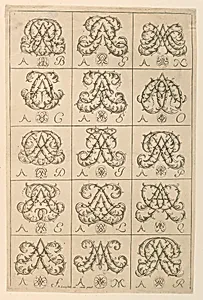
Engraving: Monograms of Two Letters
Classification
ephemera
Department
Smithsonian Collection
Museum
Smithsonian American Art Museum
Credit
Gift of Eleanor and Sarah Hewitt
Accession Number
1925-2-790
Rights
Public Domain
About this artwork
Research in Progress
Art Historical Context
**Engraving: Mon of Two Letters** *Nicolas Langlois (French, 1640–1703), ca. 1765* Smithsonian American Art Museum, Gift of Eleanor and Sarah This delicate engraving by French printmaker Nicolas Langlois showcases intertwined monograms formed by two letters, a charming example of 18th-century design. Langlois, active in Paris during the late Baroque era, specialized in prints that bridged fine art and everyday ornamentation. Though dated around 1765—after his lifetime—this work likely reflects the enduring legacy of his workshop, where such patterns were reproduced for practical use. Monograms like these were highly prized for personalizing linens, stationery, bookbindings, and silverware, embodying the era's fascination with elegant, individualized embellishment. As ephemera, this piece highlights the accessibility of engraving techniques, which allowed intricate designs to be mass-produced affordably. Etching or line engraving would have captured the fluid curves and symmetries typical of French ornamental style, influencing craftspeople across Europe. Its classification as ephemera underscores its role in daily life rather than gallery walls, offering a glimpse into the refined tastes of the Rococo-influenced period. Generously gifted to the Smithsonian American Art Museum by sisters Eleanor and Sarah Hewitt—pioneering collectors of design objects—this engraving invites us to appreciate the artistry in the commonplace. Ongoing research promises to reveal more about its creation, but it already whispers of a world where even initials held artistic grace. (198 words)