
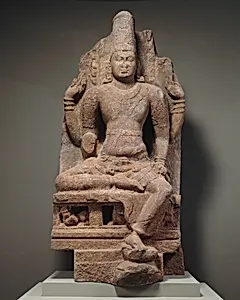
Enthroned Vishnu
Unknown Artist
second half of the 8th–early 9th century
Medium
Granulite
Dimensions
H. 9 ft. 9 in. (296.8 cm)
Classification
Sculpture
Culture & Period
India · Pandyan period (early 4th–13th century)
Department
Asian Art
Museum
Metropolitan Museum of Art, New York, NY
Credit
Purchase, The Charles Engelhard Foundation Gift, in memory of Charles Engelhard, 1984
Accession Number
1984.296
Rights
Public Domain
Tags
Art Historical Context
This monumental sculpture of Enthroned Vishnu, carved from durable granulite stone, stands nearly ten feet tall and dates to the second half of the eighth through early ninth century during India’s Pandyan period. Created in southern India, where the Pandyan dynasty flourished, the work reflects the era’s deep devotion to Hindu traditions and temple arts. Vishnu, one of Hinduism’s principal deities known as the preserver of the universe, is shown seated in regal authority, underscoring his role as cosmic protector. The impressive scale and hard-stone medium suggest this figure once formed part of a grand temple setting, where its commanding presence would have inspired worshippers. Granulite’s fine grain allowed artisans to render intricate details of adornment and posture, highlighting the technical skill of Pandyan sculptors. Acquired by the Metropolitan Museum of Art in 1984, the piece offers visitors a vivid connection to South India’s rich artistic and spiritual heritage from over a millennium ago.