
Equal-Arm Brooch
Unknown Artist
ca. 650–750
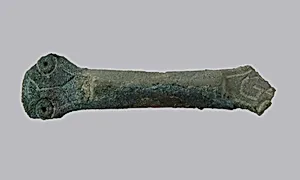
Medium
Copper alloy
Dimensions
Overall: 1 7/8 x 1/2 x 5/16 in. (4.8 x 1.2 x 0.8 cm)
Classification
Metalwork-Copper alloy
Culture
Frankish
Department
Medieval Art
Museum
Metropolitan Museum of Art, New York, NY
Credit
Gift of J. Pierpont Morgan, 1917
Accession Number
17.193.235
Rights
Public Domain
Art Historical Context
This delicate Equal-Arm Brooch crafted by an unknown Frankish artisan around 650–750 CE, exemplifies the refined metalworking of early medieval Europe. Made from copper alloy and measuring just 1 7/8 x 1/2 x 5/16 inches, its symmetrical design—two equal arms meeting at a central point with a pin mechanism—served as both a practical garment fastener and a subtle status symbol. Frankish culture, flourishing in what is now France and Germany the Merovingian period produced such jewelry to secure cloaks or tunics, blending everyday utility with artistic expression. The brooch's copper alloy medium highlights the era's accessible yet versatile metallurgy, often cast or hammered into intricate forms that showcased skilled craftsmanship without the extravagance of gold or silver reserved for elites. As a piece of Frankish metalwork, it offers a window into a transitional time when pagan traditions merged with emerging Christian influences, reflecting the mobility and trade networks of post-Roman Europe. Now housed in the Metropolitan Museum of Art's Medieval Art Department, this treasure was generously gifted by J. Pierpont Morgan in 1917. Though small, it invites visitors to marvel at the enduring ingenuity of anonymous makers whose work bridged the ancient and medieval worlds.