
Ferret
Unknown Artist
middle of the 6th century
Medium
Copper alloy
Dimensions
Overall: 1 5/8 x 3/8 x 3/16 in. (4.1 x 1 x 0.5 cm)
Classification
Metalwork-Copper alloy
Culture
Frankish
Department
Medieval Art
Museum
Metropolitan Museum of Art, New York, NY
Credit
Gift of J. Pierpont Morgan, 1917
Accession Number
17.193.103
Rights
Public Domain
Art Historical Context
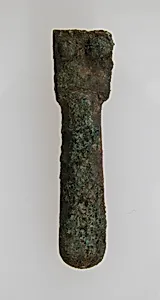
Nestled in the Metropolitan Museum of Art's Medieval collection, this petite copper alloy figurine titled *Ferret* captures the ingenuity of Frankish metalworkers from the mid-6th century. Measuring just 1 5/8 x 3/8 x 3/16 inches, its diminutive scale belies the exquisite craftsmanship involved in casting and detailing this lively depiction of a ferret—a sleek, agile creature often associated with hunting in early medieval Europe. Gifted to the Museum by J. Pierpont Morgan in 1917, it exemplifies the enduring appeal of portable, finely wrought metal objects from this era. Crafted during the Merovingian period, when the Franks dominated much of Gaul (modern France and beyond), the figurine reflects the culture's mastery of copper alloy techniques. Artisans employed lost-wax casting or similar methods to achieve realistic proportions and textured fur, common in Frankish metalwork for brooches, harness fittings, or personal ornaments. Such small-scale pieces highlight the blend of functionality and artistry in daily life, where animals symbolized vitality, status, or folklore. Though the artist remains unknown, *Ferret* offers a window into Frankish society’s appreciation for nature’s ferocity, preserved through centuries to delight modern visitors. Its survival speaks to the durability of these alloys and the cultural exchanges across early medieval trade routes.