
Equivalents
1927
Medium
gelatin silver print
Dimensions
sheet (trimmed to image): 9 x 11.6 cm (3 9/16 x 4 9/16 in.) mount: 34.2 x 27.3 cm (13 7/16 x 10 3/4 in.)
Classification
Photograph
Department
CPH
Museum
National Gallery of Art, Washington, D.C.
Credit
Alfred Stieglitz Collection
Accession Number
1949.3.990
Rights
Public Domain
Art Historical Context
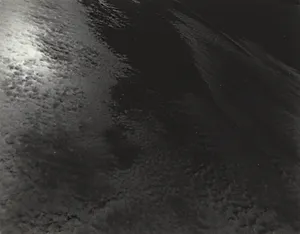
Alfred Stieglitz's *Equivalents* (192) is a captivating gelatin silver print, a medium that revolutionized photography in the early 20th century by rich tonal range and exquisite detail in black-and-white. This intimate work, with its trimmed sheet measuring just 9 x11.6 cm mounted on a larger 34.2 x 27.3 cm support, invites close contemplation, much like a precious drawing or painting. Stieglitz, a pioneering advocate for photography as a fine art, created the *Equivalents* series in the 1920s to demonstrate the medium's potential for emotional abstraction. These cloud studies—often simply sky and vapor—served as "equivalents" for the artist's inner states, challenging viewers to experience photography beyond literal representation, akin to music or poetry. Through his Photo-Secession movement and gallery 291, Stieglitz elevated the camera's gaze to modernist heights. Housed in the National Gallery of Art's Alfred Stieglitz Collection (CPH Department), this piece underscores photography's cultural shift from documentation to personal expression, influencing generations of artists to explore abstraction and subjectivity. Pause here and let the clouds stir your own equivalents.
About the Artist
Alfred Stieglitz · 1864–1946
Alfred Stieglitz (1864-1946) was a pioneering American photographer, art dealer, publisher, and advocate for the Modernist movement who was instrumental over his 50-year career in making photography an accepted art form. Born in Hoboken, New Jersey, to German Jewish immigrant parents, Stieglitz spent his formative years studying mechanical engineering in Berlin, where he discovered photography in ...