
E.R. Hughes
1826 to 1850
Medium
lithograph
Classification
Department
CG-E
Museum
National Gallery of Art, Washington, D.C.
Credit
Gift of George Matthew Adams in memory of his mother, Lydia Havens Adams
Accession Number
1955.12.31
Rights
Public Domain
Art Historical Context
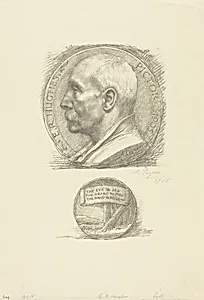
**E.R. Hughes** is a striking lithograph by Alphonse Legros (1837–1911), a French-born artist who bridged Realism and the British etching revival after settling in London in 1863. Created between 1826 and 1850, this print captures Legros's early mastery of lithography—a revolutionary 19th-century technique invented by Alois Senefelder that allowed artists to draw directly on stone for nuanced tonal effects, mimicking the fluidity of pencil or chalk. Likely a portrait of its titular subject, the work exemplifies Legros's precise linework and subtle modeling, hallmarks of his printmaking that drew inspiration from masters like Rembrandt. Lithographs like this were pivotal in democratizing art, enabling affordable reproductions for wider audiences during an era of rapid industrialization and expanding print culture. Legros, a professor at the Slade School of Art, championed such media, influencing a generation of British artists. Housed in the National Gallery of Art's Department of Prints (CG-E), this piece was generously gifted by George Matthew Adams in memory of his mother, Lydia Havens Adams, underscoring its enduring cultural value. Visitors will appreciate how **E.R. Hughes** reflects the intimate, accessible power of 19th-century prints, blending technical innovation with personal portraiture.
About the Artist
Alphonse Legros · 1837–1911
Alphonse Legros (1837–1911) was born in Dijon, France, and trained in Paris at the drawing school of Horace Lecoq de Boisbaudran, whose unconventional teaching method — which emphasised memory drawing and acute observation over academic convention — would leave a lasting mark on Legros's practice. At Lecoq's school he formed friendships with Jules Dalou and Auguste Rodin that endured throughout hi...