
Erasmus of Rotterdam
1526
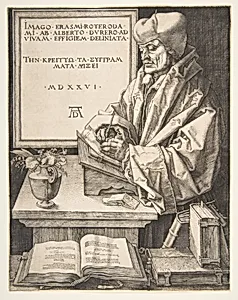
Medium
Engraving
Dimensions
sheet: 9 3/4 x 7 1/2 in. (24.8 x 19.1 cm) trimmed within plate line at top and bottom, slight margin at sides
Classification
Prints
Department
Drawings and Prints
Museum
Metropolitan Museum of Art, New York, NY
Credit
Fletcher Fund, 1919
Accession Number
19.73.120
Rights
Public Domain
Tags
Art Historical Context
Albrecht Dürer's *Erasmus of Rotterdam* (1526) is a engraving capturing the renowned Dutch philosopher and humanist scholar Desiderius Erasmus in a moment of intellectual contemplation. Depicted with books and writing implements, Erasmus embodies the Renaissance ideal of the learned man, surrounded by symbols of knowledge that reflect his prolific output as a theologian, satirist, and advocate for church reform. This intimate portrait, measuring about 9¾ x 7½ inches, showcases Dürer's unparalleled skill in the Northern Renaissance tradition. As one of the greatest printmakers of his era, Dürer elevated engraving to an art form rivaling painting, using fine lines and intricate cross-hatching to convey texture, depth, and personality in a compact format. Created late in his career, this work draws from a drawing by Hans Holbein the Younger, highlighting the collaborative networks among Renaissance artists. Distributed widely through prints, it helped immortalize Erasmus's influence across Europe. Housed in the Metropolitan Museum of Art's Drawings and Prints department (Fletcher Fund, 1919), this piece underscores the cultural power of affordable prints in disseminating humanist ideas during a time of religious and intellectual upheaval. A testament to Dürer's technical genius and Erasmus's enduring legacy.
About the Artist
Albrecht Dürer · 1471–1528
Albrecht Dürer (1471–1528) stands as the preeminent figure of the Northern Renaissance and arguably the most influential artist in the history of printmaking. Born in Nuremberg on May 21, 1471, and dying in the same city on April 6, 1528, Dürer revolutionized the status of the artist in Northern Europe, transforming printmaking from a commercial craft into an independent fine art and establishing ...