
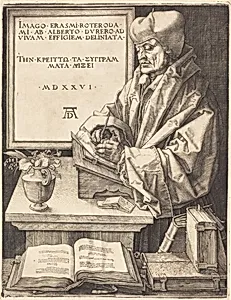
Erasmus of Rotterdam
1526
Medium
engraving on laid paper
Dimensions
plate: 24.9 × 19.1 cm (9 13/16 × 7 1/2 in.) sheet: 25.8 × 19.5 cm (10 3/16 × 7 11/16 in.)
Classification
Department
CG-E
Museum
National Gallery of Art, Washington, D.C.
Credit
Rosenwald Collection
Accession Number
1943.3.3554
Rights
Public Domain
Art Historical Context
Albrecht Dürer's *Erasmus of Rotterdam* (1526) is a masterful engraving capturing the likeness of the renowned Dutch humanist scholar Desiderius Erasmus, a leading intellectual of the Northern Renaissance. Created late in Dürer's career—just two years before his death—this portrait reflects the artist's deep admiration for Erasmus, whom he never met in person but depicted based on medals and descriptions sent by the scholar himself. Dürer produced two versions that year, showcasing Erasmus in profile against a simple background, emphasizing his thoughtful expression and scholarly attire. As a pinnacle of Renaissance printmaking, the work exemplifies Dürer's unparalleled skill in engraving, where he meticulously incised fine lines into a copper plate using a burin, achieving extraordinary detail and tonal depth on laid paper—a traditional medium with visible chain lines that enhanced the print's texture. Measuring about 25 x 19.5 cm, this intimate format allowed for widespread dissemination, making high art accessible beyond paintings. Housed in the National Gallery of Art's Rosenwald Collection, the print symbolizes the era's fusion of art, humanism, and reformist thought. Erasmus's praise for Dürer's talent underscores their mutual respect, bridging German craftsmanship with intellectual fervor and influencing generations of printmakers. A testament to precision and intellect, it invites visitors to ponder the power of the printed image in shaping cultural legacies.
About the Artist
Albrecht Dürer · 1471–1528
Albrecht Dürer (1471–1528) stands as the preeminent figure of the Northern Renaissance and arguably the most influential artist in the history of printmaking. Born in Nuremberg on May 21, 1471, and dying in the same city on April 6, 1528, Dürer revolutionized the status of the artist in Northern Europe, transforming printmaking from a commercial craft into an independent fine art and establishing ...