
Ergriffenheit
1900
Medium
Öl auf Leinwand
Dimensions
115 × 70,5 cm
Classification
Gemälde
Department
Belvedere Collection
Museum
Belvedere
Credit
Belvedere, Vienna
Accession Number
1942
Rights
Public Domain
About this artwork
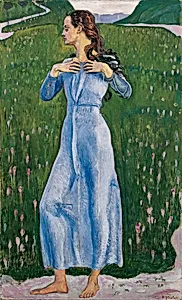
Barfuß, im blassblauen Kleid steht eine junge Frau anmutig inmitten einer Landschaft. Wie eine Tänzerin hat sie ihre Hände zur Brust gehoben, während sie das Gesicht von uns abwendet. Der Schweizer Maler Ferdinand Hodler stellt in diesem Werk seine Frau Berthe dar. In einer früheren Präsentation trägt es noch den Titel „Frau auf blühender Wiese“. Der spätere Bildtitel „Ergriffenheit“ erklärt die Dargestellte schließlich zur allegorischen Verkörperung einer besonderen Empfindung. Hodler gilt als ...
Art Historical Context
Ferdinand Hodler’s *Ergriffenheit* (1900) captures a quiet yet powerful moment of emotion. Barefoot and dressed in a pale blue, a young woman stands gracefully in a flowering meadow, her hands raised delicately to her chest like a dancer while her face turns away from viewer. Originally exhibited under the title *Frau auf blühender Wiese*, the later name “Ergriffenheit” elevates the figure into an allegory of deep feeling or being moved, inviting viewers to sense rather than simply observe. Hodler, a leading figure in the Jugendstil movement and a member of the Wiener Secession, brought his distinctive linear style and symbolic approach to this oil on canvas. The work was shown at the XIX Secession Exhibition in Vienna in 1904, where collector Carl Reininghaus acquired it. In 1918 he donated the painting to what is now the Belvedere, ensuring its place in the museum’s celebrated collection of Austrian and international modern art. Measuring 115 × 70.5 cm, the canvas exemplifies Hodler’s ability to blend portraiture with allegory, using his wife Berthe as both a personal subject and a universal symbol of inner experience.