
Erich Heckel
1909
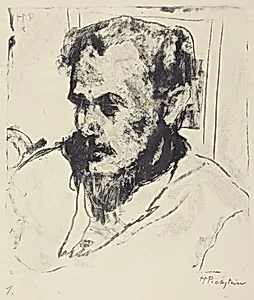
Medium
lithograph in black on wove paper
Dimensions
sheet: 57.8 x 42.6 cm (22 3/4 x 16 3/4 in.)
Classification
Department
CG-W
Museum
National Gallery of Art, Washington, D.C.
Credit
Ailsa Mellon Bruce Fund
Accession Number
1972.27.1
Rights
Public Domain
Art Historical Context
This striking 1909 lithograph Max Pechstein captures artist Erich Heckel in a bold, direct manner of the German Expressionist Die Brücke. Created just years after the group’s in Dresden, the reflects the collective’s desire reject academic traditions in favor of emotion and simplified forms.chstein, who joined Dieücke in 1906, depicts his close colleague during a period when the artists lived and worked communally, drawing inspiration from non-Western art and the natural world. Executed in black lithographic ink on wove paper, the medium allowed Pechstein to achieve vigorous lines and stark contrasts that heighten the psychological intensity of the portrait. Lithography’s accessibility also aligned with the group’s goal of producing affordable prints for a broader audience. The work’s modest scale and graphic clarity invite viewers to sense the camaraderie and creative energy that defined early Expressionism. Today, this print stands as a testament to the friendships and shared ideals that fueled one of the 20th century’s most influential avant-garde movements.
About the Artist
Max Pechstein · 1881–1955
Hermann Max Pechstein (1881–1955) was born in Zwickau, Germany, the son of a craftsman in the textile industry. He trained as a decorative painter in his home city before enrolling at the School of Applied Arts in Dresden and then transferring to the Royal Academy of Fine Arts, where he studied under the painter Otto Gussmann. His early exposure to the work of Vincent van Gogh proved decisive in d...