
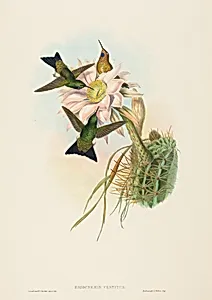
Eriocnemis vestitus (Glowing Puff-Leg)
1801 to 1825
Medium
hand-colored lithograph
Dimensions
sheet: 56 × 38.7 cm (22 1/16 × 15 1/4 in.)
Classification
Department
CG-E
Museum
National Gallery of Art, Washington, D.C.
Credit
Gift of Dr. and Mrs. George Benjamin Green
Accession Number
1970.25.8
Rights
Public Domain
Art Historical Context
This exquisite hand-colored lithograph captures the vibrant beauty of the Glowing Puffleg hummingbird, known scientifically as Eriocnemis vestitus. Created by renowned ornithological illustrator John Gould in collaboration with H.C. Richter between 1801 and 1825, the print exemplifies the era’s growing fascination with exotic natural history subjects. Gould’s works were celebrated for their meticulous attention to feather textures, iridescent colors, and lifelike poses, transforming scientific documentation into works of art that brought distant species to European audiences. Measuring 56 by 38.7 centimeters, this lithograph showcases the demanding technique of hand-coloring, where artists applied delicate watercolor washes over printed outlines to achieve the bird’s luminous plumage and distinctive puffed leg feathers. Such prints played a vital role in 19th-century ornithology, serving both as educational tools for scholars and as prized decorative pieces for collectors. Today, this piece from the National Gallery of Art’s collection highlights the intersection of art and science during the golden age of exploration. It invites viewers to appreciate both the hummingbird’s natural elegance and the skillful craftsmanship that preserved its image for generations.
About the Artist
John Gould and H.C. Richter
John Gould (1804–1881) and Henry Constantine Richter (1821–1902) formed one of the most productive and celebrated partnerships in the history of natural history illustration. Gould, an English ornithologist and publisher of extraordinary ambition, built a career on the production of lavishly illustrated folio volumes documenting the birds of Britain, Europe, Australia, Asia, and the Americas. Thou...