
Erotic Print
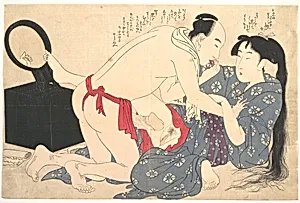
Medium
Woodblock print; ink and color on paper
Dimensions
Image: 10 in. × 15 1/8 in. (25.4 × 38.4 cm) Image: 15 1/2 × 22 3/4 in. (39.4 × 57.8 cm)
Classification
Prints
Culture & Period
Japan · Edo period (1615–1868)
Department
Asian Art
Museum
Metropolitan Museum of Art, New York, NY
Credit
Anonymous Gift, 1951
Accession Number
JP3158
Rights
Public Domain
Tags
Art Historical Context
This captivating *Erotic Print* by Kitagawa Utamaro a master of Japan's Edo period (1615–1868), exemplifies the ukiyo-e tradition of "pictures of the floating world."amaro, renowned for bijin-ga (images of beautiful women), often explored intimate themes in shunga—erotic woodblock prints were privately produced and cherished across social classes, from merchants to samurai. Created using ink and color on paper, work measures approximately 10 × 15 inches for the image, with a full sheet of 15½ × 22¾ inches, inviting viewers into a sensual, private moment featuring male and female nudes. Utamaro's artistic genius shines in his precise lines, vibrant yet subtle colors, and innovative use of the woodblock printing technique, where multiple carved blocks were inked and overlaid for rich depth. This medium democratized art during the Edo era, making high-quality prints affordable and portable, while shunga's stylized eroticism blended humor, beauty, and everyday life, reflecting Japan's tolerant attitudes toward sexuality. Housed in the Metropolitan Museum of Art's Asian Art Department as an anonymous gift from 1951, this print offers a window into a vibrant cultural undercurrent, where erotic art was both artistic pinnacle and social commentary, far from mere titillation.
About the Artist
Kitagawa Utamaro · 1753–1806
Kitagawa Utamaro (c. 1753-1806) was one of the most celebrated masters of ukiyo-e woodblock printing, revolutionizing the art of bijin-ga (pictures of beautiful women) during Japan's Edo period. Born Kitagawa Ichitaro, his early life remains shrouded in mystery, with conflicting accounts placing his birth in Kyoto, Osaka, Yoshiwara in Edo (modern Tokyo), or Kawagoe in Musashi Province. Under the t...