
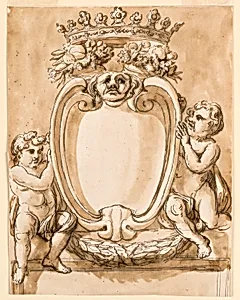
Escutcheon as an overdoor
Classification
graphic design
Department
Smithsonian Collection
Museum
Smithsonian American Art Museum
Credit
Museum purchase through gift of various donors and from Eleanor G. Hewitt Fund
Accession Number
1938-88-1824
Rights
Public Domain
About this artwork
Research in Progress
Art Historical Context
This intriguing artwork, titled "Escutcheon as an overdoor," was created around 1775 by the Italian artist Giuseppe Bar (1746–180). An escut is a shield-shaped motif drawn from herald traditions, here designed as an ornamental feature to sit above a doorway. Classified as graphic design, the piece likely functioned as a preparatory drawing or conceptual study, highlighting Barberi’s role in the decorative arts of late-18th-century Italy. Overdoor decorations like this were a popular way to add grandeur and symbolic meaning to interiors of palaces, churches, and residences across Europe. Barberi’s design reflects the period’s interest in blending functionality with refined ornament, capturing the tastes of an era when artists collaborated closely with architects and patrons. Acquired by the Smithsonian American Art Museum through gifts from various donors and the Eleanor G. Hewitt Fund, the work now connects European design heritage with American collections. Though the specific medium remains unknown and research continues, this piece offers a window into the creative process behind architectural embellishment. It invites viewers to appreciate how such graphic works translated ideas into lasting visual environments, enriching our understanding of 18th-century artistic practice.