
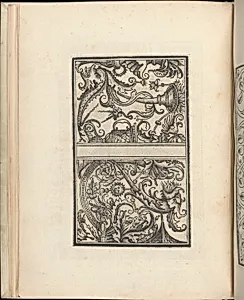
Esemplario di lavori, page 5 (verso)
August 1529
Medium
Woodcut (pages inlaid, modern vellum binding)
Dimensions
9 5/16 x 7 1/4 x 15/16 in. (23.7 x 18.4 x 2.4 cm)
Classification
Books|Prints|Ornament & Architecture
Department
Drawings and Prints
Museum
Metropolitan Museum of Art, New York, NY
Credit
Rogers Fund, 1921
Accession Number
21.98(9)
Rights
Public Domain
Tags
Art Historical Context
Step into the intricate world of Renaissance design with page 5 (verso) from *Esemplario di lavori*, a pattern book crafted by the Venetian printer Nicolò Zoppino in August 1529. This woodcut print, housed in the Metropolitan Museum of Art's Drawings and Prints department, exemplifies the explosion of printed ornament books during Italy's High Renaissance. Zoppino, known for his prolific output of decorative manuals, created these "esemplari" (model books) to inspire artisans across Europe, offering repeatable motifs for crafts like embroidery, lace-making, and metalwork. The page features elegant vine patterns—a hallmark of Renaissance ornamentation—winding with natural grace and symmetry, tagged simply as "Vines" in the museum's records. Produced via woodcut, a labor-intensive relief printing technique where designs were carved into wooden blocks and inked for transfer, these 9 5/16 x 7 1/4-inch pages (bound in modern vellum) captured fluid, organic forms inspired by antiquity and nature. Such books democratized sophisticated decoration, bridging fine art and everyday crafts. Acquired through the Rogers Fund in 1921 and classified under Books, Prints, Ornament & Architecture, this artifact highlights printing's role in cultural dissemination. It reminds us how Zoppino's innovations fueled the decorative arts, turning vine scrolls into timeless symbols of Renaissance elegance.
About the Artist
Nicolò Zoppino · 1478–1544
Nicolò Zoppino was an Italian printer and publisher active in Venice and other Italian cities during the first half of the sixteenth century, occupying an important place in the history of early printing and book illustration. Born around 1478, he worked during the golden age of Venetian printing, a period when the city was the dominant center of book production in Europe and publishers competed t...