
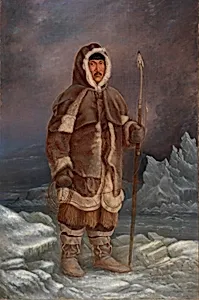
Eskimo Man
Medium
Painting
Classification
Painting
Department
Smithsonian Collection
Museum
Smithsonian American Art Museum
Credit
Smithsonian American Art Museum, Museum acquisition
Accession Number
1985.66.165,699
Rights
Public Domain
Tags
Art Historical Context
**Eskimo Man** (ca. 1893) is a compelling painting by Antonion Z Shindler, a Bulgarian artist (1813–9) who spent his later years in Washington,. Created toward the end of his life, this work captures a male Inuit figure, reflecting the late 19th-century fascination indigenous peoples amid America's growing ethnographic collections. Housed in the Smithsonian American Art Museum's collection through a museum acquisition, it exemplifies how art intersected with scientific documentation during this era. Shindler's portrait likely emphasizes the subject's dignified presence against a winter backdrop, as suggested by tags highlighting an Inuit man in a cold-season setting. As an oil or similar painting medium typical of the time, it would have used techniques to convey texture—fur-lined parkas, frost-kissed features—bringing remote Arctic cultures to urban audiences. This piece underscores the Smithsonian's role in preserving visual records of diverse peoples, blending artistic portraiture with cultural observation. Today, **Eskimo Man** invites reflection on how 19th-century artists bridged worlds, offering visitors a window into Inuit resilience and the evolving narrative of representation in American art. (178 words)