
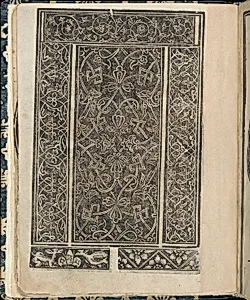
Essempio di recammi, page 14 (verso)
Medium
Woodcut
Dimensions
Overall: 7 13/16 x 6 3/16 x 3/8 in. (19.8 x 15.7 x 1 cm)
Classification
Books|Prints|Ornament & Architecture
Department
Drawings and Prints
Museum
Metropolitan Museum of Art, New York, NY
Credit
Harris Brisbane Dick Fund, 1935
Accession Number
35.75.3(28)
Rights
Public Domain
Tags
Art Historical Context
This woodcut comes from *Essempio di recammi* (“Examples of Embroidery”), a pattern book published in Venice in 1530 by Giovanni Antonio Tagliente and the brothers Nicolini da Sabio. Created during the height of the Italian Renaissance, such books were among the first printed resources to circulate ornamental designs widely, allowing embroiderers, lacemakers, and other artisans to copy motifs for clothing, household linens, and furnishings. The page measures just under eight inches tall, its compact format ideal for studio or workshop use. The verso of page 14 displays delicate woodcut ornaments featuring birds, dogs, and flowering vines—motifs typical of early-sixteenth-century decorative vocabulary. Tagliente, a calligrapher and printer, specialized in instructional manuals that bridged the worlds of typography, drawing, and the applied arts. By translating hand-drawn patterns into repeatable woodblocks, he helped democratize access to fashionable designs previously available only through costly manuscripts or direct apprenticeship. Acquired by the Metropolitan Museum in 1935, this sheet preserves an important moment when printmaking began to shape everyday material culture. Its crisp lines and balanced compositions still reward close looking, revealing how Renaissance artists turned the printed page into a portable treasury of ornament.
About the Artist
Giovanni Antonio di Nicolini da Sabio e i fratelli|Giovanni Antonio Tagliente (Italian|Italian) · 1522 |1465 –1545 |1528
Italian, active Venice, ca. 1522–1545|Italian, Venice ca. 1465–1528 Venice