
Trionfo Di Virtu. Libro Novo..., page 12 (recto)
1563
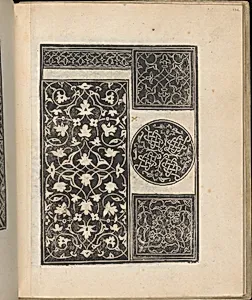
Medium
Woodcut
Dimensions
Overall: 9 13/16 x 7 7/8 in. (25 x 20 cm)
Classification
Books|Prints|Ornament & Architecture
Department
Drawings and Prints
Museum
Metropolitan Museum of Art, New York, NY
Credit
Harris Brisbane Dick Fund, 1937
Accession Number
37.47.1(22)
Rights
Public Domain
Tags
Art Historical Context
Step into the opulent world of Renaissance Venice with *Trionfo Di Virtu. Libro Novo...*, page 12 (recto), a delicate woodcut by Matteo Pagano from 1563. Pagano, a prolific Venetian publisher and engraver, crafted this page as part of a "New Book" celebrating the Triumph of Virtue—an allegorical theme blending moral philosophy with decorative splendor. Measuring 9 13/16 7 7/8 inches, it exemplifies the era's pattern books, which served as treasure troves for artists, architects, and craftsmen seeking inspiration in ornamentation. Rendered in woodcut—a labor-intensive relief printing technique where intricate designs were carved into wooden blocks—this print showcases floral motifs, likely intertwined with architectural elements. Woodcuts like this were revolutionary for their reproducibility, flooding workshops across Europe with motifs that adorned everything from textiles to facades. Pagano's precise lines capture the grotesque style popular in the 16th century, echoing ancient Roman discoveries and the whimsical inventions of Raphael's school. Housed in the Metropolitan Museum of Art's Drawings and Prints department (Harris Brisbane Dick Fund, 1937), this page highlights Venice's dominance in printmaking, bridging fine art and applied design. It invites us to appreciate how such humble illustrations fueled the Renaissance's decorative fever, turning virtue's triumph into blooming, enduring beauty.
About the Artist
Matteo Pagano · 1515–1588
**Matteo Pagano (c. 1515–1588)** was a prominent Venetian printer, publisher, woodcut artist, and illustrator whose innovative designs bridged fine art and the decorative crafts during the Renaissance. Little is known about his early life, which remains sparsely documented, but he began his career as a woodblock cutter, working for the publisher Nicolò Zoppino on pattern books before establishing ...