
Estuary at Day's End
c. 1640/1645
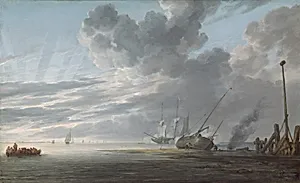
Medium
oil on panel
Dimensions
overall: 36.8 x 58.4 cm (14 1/2 x 23 in.) framed: 50.2 x 72.4 x 6.7 cm (19 3/4 x 28 1/2 x 2 5/8 in.)
Classification
Painting
Department
CNE-B
Museum
National Gallery of Art, Washington, D.C.
Credit
Patrons’ Permanent Fund and The Lee and Juliet Folger Fund in memory of Kathrine Dulin Folger
Accession Number
1997.101.1
Rights
Public Domain
Art Historical Context
Simon de Vlieger's *Estuary at Day's*, painted around 1640–1645, captures the tranquil beauty of a Dutch waterway during the Golden Age of the Netherlands. As a prominent marine painter from the Haarlem school, de Vlieger specialized in seascapes and coastal scenes, reflecting the era's fascination with the sea—vital to Holland's maritime economy and global trade. This oil on panel, measuring a intimate 36.8 x 58.4 cm, invites viewers into a serene estuary bathed in the soft, fading light of dusk, evoking the calm after a day's labors. De Vlieger's masterful use of oil on panel allowed for rich, luminous effects, with subtle glazes building atmospheric depth and realistic water reflections. His style bridges the meticulous detail of earlier Dutch landscapists and the tonal harmony that influenced later masters like the van de Veldes, whom he taught. The composition likely features ships at anchor and expansive skies, hallmarks of his oeuvre, emphasizing nature's quiet power. Housed in the National Gallery of Art, Washington, D.C., thanks to the Patrons’ Permanent Fund and the Lee and Juliet Folger Fund, this gem offers a window into 17th-century Dutch life. It reminds us how artists like de Vlieger celebrated everyday coastal vistas, turning humble estuaries into poetic meditations on time and tide.
About the Artist
Simon de Vlieger · 1600–1653
Simon de Vlieger (c. 1600/1601–1653) was a leading Dutch marine painter of the Golden Age, born in Rotterdam where he married Anna Gerridts van Willige in 1627. His early training remains undocumented, though his initial works reflect the influence of tonal marine painting pioneered by Jan Porcellis, from whose monochrome palette de Vlieger transitioned toward more vibrant colors, precise ship det...