
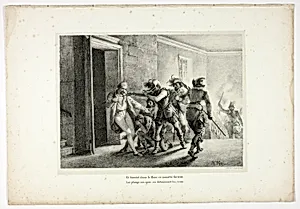
Et bientôt dans le flanc ce monstre furieux...
1825
Medium
Lithograph in black on gray chine, laid down on ivory wove paper (chine collé)
Dimensions
Image: 19.1 × 26.2 cm (7 9/16 × 10 3/8 in.); Primary support: 20.4 × 27.3 cm (8 1/16 × 10 3/4 in.); Secondary support: 28.7 × 41.4 cm (11 5/16 × 16 5/16 in.)
Classification
lithograph
Department
Prints and Drawings
Museum
Art Institute of Chicago
Accession Number
127405
Rights
Public Domain
Art Historical Context
**Et bientôt dans le fl ce monstre furieux** (1825) is a dramatic lithograph by Horace Vernet a leading French artist of the Romantic era renowned for his vivid history paintings and military scenes. The title, drawn from Virgil's *Aeneid*, evokes the moment of the Trojan Horse breaching Troy's walls—"And soon in the flank this monster..."—capturing the tension and impending doom as Greek warriors emerge from the wooden beast. Vernet's dynamic composition reflects Romanticism's emphasis on emotion, heroism, and epic narratives, drawing viewers into the chaos of ancient myth reimagined through a 19th-century lens. Printed in black ink on delicate gray chine paper, then laid down on ivory wove support via the chine collé technique, this work exemplifies early lithography's revolutionary potential. Invented just decades earlier, lithography allowed artists like Vernet—son and grandson of painters—to produce rich, painterly tones and fine details with crayon-like fluidity, making high-quality reproductions accessible beyond elite patrons. At 19.1 × 26.2 cm, its intimate scale invites close inspection in the Art Institute of Chicago's Prints and Drawings collection. Vernet's piece bridges classical literature and modern printmaking, highlighting 1820s France's fascination with antiquity amid post-Napoleonic cultural revival. A testament to his versatility, it showcases how prints democratized art, sparking imagination in homes and salons alike.
About the Artist
Horace Vernet · 1789–1863
**Horace Vernet** (full name Émile Jean-Horace Vernet) was a leading French painter of the nineteenth century, renowned for his dynamic battle scenes, portraits, and Orientalist subjects. Born on 30 June 1789 in Paris at the Louvre during the French Revolution, he came from a distinguished artistic dynasty. He was the son of the equestrian and military painter Carle Vernet and the grandson of the ...