
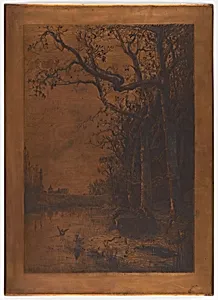
Etched copperplate "Landscape with Ducks" by Adolphe Appian
1877-1879
Classification
Printing plate
Department
Smithsonian Collection
Museum
Smithsonian American Art Museum
Credit
Smithsonian American Art Museum
Accession Number
1951-91-1
Rights
Public Domain
About this artwork
Research in Progress
Art Historical Context
Adolphe Appian (1818–1898), a prominent French artist of the Barbizon School, the serene beauty of nature in his etched copperplate *Landscape with Ducks* (1877–1879). As a master etcher and landscape painter, Appian drew inspiration from the rural French countryside, emphasizing atmospheric effects and naturalistic details. This printing plate, preserved in the Smithsonian American Art Museum collection, exemplifies his dedication to translating the subtle play of light and water into intricate lines. Etching on copperplate was a hallmark of the 19th-century etching revival, allowing artists like Appian to achieve rich tonal variations through acid-biting techniques. Unlike paintings, these plates could produce multiple impressions, making fine art more accessible. Appian's work reflects the era's Romantic fascination with unspoiled landscapes, blending meticulous observation with poetic tranquility—imagine ducks gliding across a misty pond, rendered with exquisite precision. Though research on this piece is ongoing, it highlights Appian's enduring influence on printmaking, bridging European traditions with American collections. A testament to 19th-century artistry, it invites visitors to appreciate the tactile craft behind evocative scenes of everyday wonder. (178 words)