
Eucephala caerulea (Blue-chinned Sapphire)
1801 to 1825
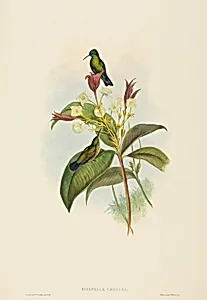
Medium
hand-colored lithograph
Dimensions
sheet: 56 × 38.8 cm (22 1/16 × 15 1/4 in.)
Classification
Department
CG-E
Museum
National Gallery of Art, Washington, D.C.
Credit
Gift of Dr. and Mrs. George Benjamin Green
Accession Number
1972.77.19
Rights
Public Domain
Art Historical Context
This hand-colored lithograph captures the Blue-chinned Sapphire, a striking hummingbird species known for its iridescent plumage. Created by John Gould, the renowned 19th-century ornithologist and illustrator, in collaboration with H.C. Richter, the work exemplifies the detailed natural history prints that brought exotic birds to European audiences during the early 1800s. The image highlights the bird’s shimmering blue-green throat and delicate form, rendered with scientific precision and artistic sensitivity. Gould and Richter frequently employed lithography for its ability to reproduce fine lines and textures, which were then meticulously hand-colored to convey the jewel-like qualities of hummingbird feathers. Produced between 1801 and 1825, this sheet reflects the era’s growing fascination with biodiversity and exploration, when such prints served both as educational tools and objects of beauty in private collections and museums. Measuring 56 by 38.8 cm, the print’s scale allows viewers to appreciate the subtle gradations of color and the bird’s graceful posture. Today it resides in the National Gallery of Art as part of a generous gift, preserving a moment when art and science converged to celebrate the natural world.
About the Artist
John Gould and H.C. Richter
John Gould (1804–1881) and Henry Constantine Richter (1821–1902) formed one of the most productive and celebrated partnerships in the history of natural history illustration. Gould, an English ornithologist and publisher of extraordinary ambition, built a career on the production of lavishly illustrated folio volumes documenting the birds of Britain, Europe, Australia, Asia, and the Americas. Thou...