
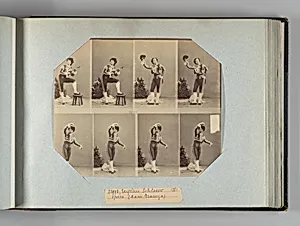
Eugénie Schlosser dans Gracioza
Medium
Albumen silver print from glass negative
Dimensions
Image: 7 3/8 × 9 1/4 in. (18.8 × 23.5 cm) Album page: 10 3/8 × 13 3/4 in. (26.3 × 35 cm)
Classification
Photographs
Department
Photographs
Museum
Metropolitan Museum of Art, New York, NY
Credit
Gilman Collection, Gift of The Howard Gilman Foundation, 2005
Accession Number
2005.100.588.1.109
Rights
Public Domain
Art Historical Context
In 1861, French photographer André-Adolphe-Eugène Disdéri *Eugénie Schlosser dans Gracioza*, a striking albumen silver print portraying the actress Eugénie Schlosser her theatrical role as Gracioza. Disdéri, a pioneer in commercial photography, helped popularize the carte de visite format—small, affordable portraits that swept Europe like trading cards. Though this print is larger (7 3/8 × 9 1/4 in.), it reflects his mastery of mass portraiture, blending artistry with the era's celebrity culture. The albumen silver print, made from a glass negative, was the gold standard of 19th-century photography. Egg whites (albumen) coated the paper, creating richly toned images with fine detail and warm highlights that brought subjects to life. This technique allowed for sharp reproductions of costumes and expressions, ideal for documenting theater stars like Schlosser, whose dramatic pose evokes the Romantic stage. Housed in the Metropolitan Museum of Art's Gilman Collection, this photograph highlights photography's role in democratizing fame during the Second Empire. Visitors, imagine flipping through an album of such luminous portraits— a window into how 1860s audiences idolized performers much like we do today!
About the Artist
André-Adolphe-Eugène Disdéri · 1819–1889
**André-Adolphe-Eugène Disdéri** (1819–1889) was a pioneering French photographer whose innovations transformed portraiture into a mass medium during the Second Empire. Born on March 28, 1819, in Paris, Disdéri pursued diverse careers in commerce, acting, and politics early on, while studying art amid personal hardships following his father's death, which compelled him to support his mother, sibli...