
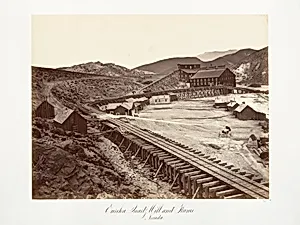
Eureka Quartz Mill and Flume, Nevada
1875, printed ca. 1876
Medium
Albumen silver print from glass negative
Classification
Photographs
Department
Photographs
Museum
Metropolitan Museum of Art, New York, NY
Credit
Gift of Carole and Irwin Lainoff, Ruth P. Lasser and Joseph R. Lasser, Mr. and Mrs. John T. Marvin, Martin E. and Joan Messinger, Richard L. Yett and Sheri and Paul Siegel, 1986
Accession Number
1986.1189.95
Rights
Public Domain
Tags
Art Historical Context
Step into the rugged heart of Nevada's mining boom with Carleton E. Watkins's *Eureka Quartz Mill and Fl, Nevada* (1875, printed ca 1876). This albumen silver print captures industrial might of the Eureka mining district, where quartz mills crushed ore and flumes channeled water to power the operations fueling America's Gilded Age expansion. Watkins, a pioneering photographer, documented the transformative clash of nature and human ambition in the post-Civil War West. The photograph's historical significance lies in its vivid portrayal of the silver rush that built boomtowns like Eureka, complete with railways snaking through the terrain to haul riches eastward. As part of the Metropolitan Museum of Art's collection, it preserves a fleeting era of innovation and exploitation, highlighting how photography promoted westward settlement. Crafted from a glass negative—a Watkins specialty for mammoth-scale detail—the albumen print yields exquisite tonal range and sharpness, making the mill's towering machinery and watery flume leap off the page. This technique, dominant in the 19th century, turned Watkins's images into windows on America's industrial frontier, blending artistry with documentary power.
About the Artist
Carleton E. Watkins · 1829–1916
Carleton E. Watkins (1829–1916), one of America's pioneering landscape photographers, was born on November 11, 1829, in Oneonta, New York, the eldest of eight children to carpenter John Watkins and innkeeper Julia. Drawn by the Gold Rush, he arrived in San Francisco in 1851 at age 22 alongside childhood friend Collis Huntington, who later became a railroad tycoon. Initially working as a carpenter ...