
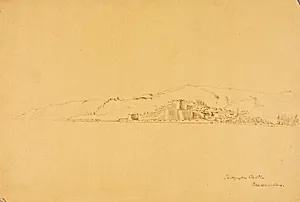
European Castle, Dardanelles
Medium
Drawing
Classification
Drawing
Department
Smithsonian Collection
Museum
Smithsonian American Art Museum
Credit
Smithsonian American Art Museum, Bequest of Martha F. Butler
Accession Number
1991.56.21
Rights
Public Domain
Tags
Art Historical Context
Nestled in the Smithsonian American Art Museum's collection *European Castle, Dardan* is a captivating drawing by 19th-century American artist Kilbourne Kellogg. Created around the mid-1800s during Kellogg's extensive travels through Europe and the Near East, this undated work captures a striking castle overlooking the Dardanelles strait—a vital waterway linking the Aegean Sea to the of Marmara in modern-day Turkey. The scene evokes the region's layered history, from ancient Troy to Ottoman fortifications, blending rugged cliffs, a quaint town, and imposing architecture that hints at strategic defenses guarding this gateway between East and West. Kellogg, known for his neoclassical portraits and vivid travel sketches, likely produced this drawing en plein air as a memento of his adventures. His style reflects the Romantic era's fascination with exotic locales, documenting architecture and landscapes with precise lines and atmospheric detail. As a drawing—bequeathed to the museum by Martha F. Butler—this piece exemplifies the preparatory medium's role in 19th-century art, allowing artists like Kellogg to capture fleeting impressions before translating them into larger oils or watercolors. For visitors, this artwork offers a window into Kellogg's wanderlust and the cultural crossroads of the Dardanelles, reminding us how American artists bridged continents in an age of exploration.