
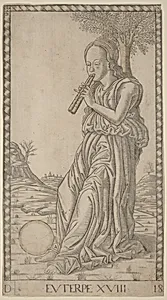
Euterpe
Medium
engraving with gilding
Dimensions
sheet: 17.8 x 9.8 cm (7 x 3 7/8 in.)
Classification
Department
CG-E
Museum
National Gallery of Art, Washington, D.C.
Credit
Ailsa Mellon Bruce Fund
Accession Number
1969.6.9
Rights
Public Domain
Art Historical Context
Behold *Euterpe*, a exquisite engraving from around 1465 by the anonymous Master of the E-Seriesocchi, one of the early Italian printmakers active in Ferrara during the Renaissance. This small gem (17.8 x 9.8 cm) depicts Euterpe, the Greek Muse of music and lyric poetry, gracefully rendered with flowing robes and a double flute, symbolizing harmony and inspiration. Part of a renowned series of 106 tarocchi cards—educational prints rather than playing cards—these works celebrated the liberal arts, muses, and virtues, blending classical mythology with Renaissance humanism. Crafted in engraving with gilding, the technique highlights the master's precision: intricate lines etched into copper plates allowed for detailed shading and mass production, while gold accents on highlights like hair and instruments lent a luxurious, illuminated-manuscript quality. Acquired through the Ailsa Mellon Bruce Fund for the National Gallery of Art's print collection (CG-E), it exemplifies 15th-century innovation in printmaking, bridging painting and graphic arts. These tarocchi cards, likely commissioned by Ferrara's Este court, served as both scholarly tools and decorative treasures, reflecting Italy's revival of antiquity amid patronage of the arts. *Euterpe* invites us to ponder music's timeless power, a muse whispering melodies across centuries.
About the Artist
Master of the E-Series Tarocchi · 1460–1475
The Master of the E-Series Tarocchi was an anonymous Italian engraver active in Ferrara around 1465, during the vibrant era of the Este court. His early life and training remain undocumented, but stylistic affinities link him to artists collaborating with Francesco del Cossa on the frescoes of Palazzo Schifanoia's Salone dei Mesi. Working in the Ferrarese tradition, he produced the pioneering E-se...