
Evacuation of Aquia Creek
June 1863
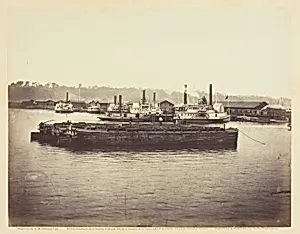
Medium
Albumen print, pl. 33 from the album "Gardner's Photographic Sketch Book of the War, vol. 1" (1866)
Dimensions
Image/paper: 17.7 × 22.9 cm (7 × 9 1/16 in.); Album page: 31.2 × 44.7 cm (12 5/16 × 17 5/8 in.)
Classification
photograph
Department
Photography and Media
Museum
Art Institute of Chicago
Accession Number
196399
Rights
Public Domain
Art Historical Context
Captured in June 1863 by photographer Timothy O'Sullivan,Evacuation of Aqu Creek* offers a stark, unflinching glimpse into American Civil War's gritty realities. O'Sullivan, a key figure wartime photography who worked with Mathew Brady and later Alexander Gardner, documented Union Army movements along Virginia's Aquia Creek, a vital route near Fredericksburg. This albumen print, plate 33 Gardner's landmark 1866 publication *Photographic Sketch Book of the, Volume 1*, depicts soldiers and wagons retreating amid the chaos of military withdrawal, likely during campaigns leading to Gettysburg. The image's historical significance lies in its raw portrayal of war's logistics and human toll, preserving moments that newspapers could not. Albumen prints, made from glass negatives coated with egg-white sensitized paper, were the era's gold standard for clarity and detail, allowing intricate textures like muddied paths and weary figures to emerge vividly. At 17.7 × 22.9 cm, it's intimate yet immersive, mounted on larger album pages for Gardner's elegant two-volume set. Housed in the Art Institute of Chicago's Photography and Media department, this work exemplifies early documentary photography's shift from staged portraits to on-the-ground realism, influencing how we visualize conflict today. A poignant reminder of sacrifice, it invites visitors to ponder the war's vast scale through one quiet evacuation.
About the Artist
Timothy O'Sullivan · 1840–1882
Timothy H. O'Sullivan (c. 1840–1882) emerged as one of America's pioneering photographers during a transformative era. His early life remains sparsely documented, with records suggesting he was born either in New York City or Ireland before immigrating young, possibly growing up on Staten Island. As a teenager, he apprenticed under Mathew Brady at his Fulton Street gallery in New York, mastering w...