
Eve
1898–99
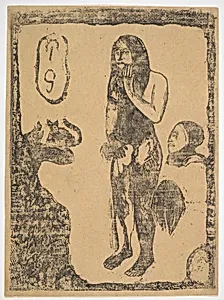
Medium
Woodcut printed in black ink on heavy light brown wove paper
Dimensions
image: 11 1/16 x 8 7/16 in. (28.1 x 21.4 cm) sheet: 12 1/16 x 8 13/16 in. (30.6 x 22.4 cm)
Classification
Prints
Department
Drawings and Prints
Museum
Metropolitan Museum of Art, New York, NY
Credit
Anonymous Gift, 2003
Accession Number
2003.446.2
Rights
Public Domain
Tags
Art Historical Context
In the late 1890s, Paul Gauguin, a pioneering Post-Impressionist, createdEve* during his second stay in Tahiti (1895–1901), where he sought escape from Western civilization and inspiration from Polynesian culture. This 1898–99 woodcut, printed in stark black ink on heavy light wove paper, captures fascination with exotic beauty and biblical motifs. Measuring just over 11 by 8 inches, the intimate image likely portrays a nude Tahitian woman as Eve,oking paradise lost amid lush, primal surroundings—a theme blending European symbolism with Gauguin's idealized vision of the South Seas. Gauguin's woodcuts from this period, including those in his *Noa Noa* suite, marked a bold departure from painting. He carved the blocks himself, embracing a crude, direct technique influenced by Japanese ukiyo-e prints and folk art. The heavy outlines and simplified forms emphasize contour over color, highlighting the figure's voluptuous form and tattoo-like patterns, which reflect his admiration for indigenous tattoos (tatau). Housed in the Metropolitan Museum of Art's Drawings and Prints department, *Eve* exemplifies Gauguin's primitivist revolution, influencing modern art by prioritizing emotional truth and non-Western aesthetics. Visitors will appreciate its raw power, a window into the artist's quest for an unspoiled Eden. (198 words)
About the Artist
Paul Gauguin · 1848–1903
Paul Gauguin (1848-1903) was a French Post-Impressionist painter whose bold experiments with color, form, and subject matter made him one of the most influential figures in the transition from 19th-century art to modernism. His rejection of European civilization for the perceived authenticity of 'primitive' cultures established an archetype of artistic exile that continues to resonate. Gauguin's ...