
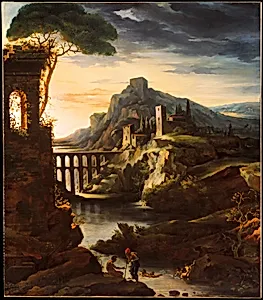
Evening: Landscape with an Aqueduct
Medium
Oil on canvas
Dimensions
98 1/2 x 86 1/2 in. (250.2 x 219.7 cm)
Classification
Paintings
Department
European Paintings
Museum
Metropolitan Museum of Art, New York, NY
Credit
Purchase, Gift of James A. Moffett 2nd, in memory of George M. Moffett, by exchange, 1989
Accession Number
1989.183
Rights
Public Domain
Tags
Art Historical Context
Théodore Géricault *Evening: Landscape with an Aqu* (1818) captures the dramatic essence of French Romanticism in a monumental oil on canvas measuring nearly 8½ by 7 feet. during Géricault's formative years, just before his masterpiece *The Raft of the Medusa*, this work reflects the movement's fascination with nature's sublime power and the fleeting beauty of twilight. The artist, known for his intense emotional realism and dynamic compositions, here shifts from human tragedy to vast landscapes, evoking the ideal of man's humble place amid ancient ruins and flowing rivers. The painting depicts a serene yet moody evening scene featuring a towering aqueduct—likely inspired by Roman engineering marvels—framed by winding rivers and distant figures of men. Géricault's masterful use of oil allows for rich, atmospheric effects: deep shadows and glowing skies that heighten the sense of transience and grandeur. This large-scale format immerses viewers, drawing them into a meditative interplay of light, water, and stone, a departure from the neoclassical order of his time. Acquired by the Metropolitan Museum of Art in 1989, this rare landscape underscores Géricault's versatility and enduring influence on 19th-century art, blending historical reverence with emotional depth for a timeless evening reverie.
About the Artist
Théodore Gericault · 1791–1824
Théodore Géricault, born Jean-Louis André Théodore Géricault on September 26, 1791, in Rouen, France, into a prosperous family—his father a lawyer turned tobacco merchant and his mother from a line of growers—moved to Paris around 1797. Displaying early artistic promise, recognized by painter Jean-Louis Laneuville, he began formal training in 1808 under Carle Vernet, mastering English sporting art...