
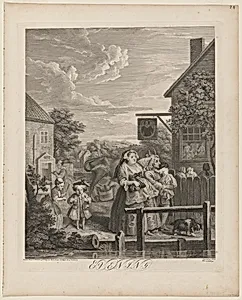
Evening
1738
Medium
etching and engraving on laid paper
Dimensions
plate: 48.5 × 40.4 cm (19 1/8 × 15 7/8 in.) sheet: 57.2 × 46.3 cm (22 1/2 × 18 1/4 in.)
Classification
Department
CG-E
Museum
National Gallery of Art, Washington, D.C.
Credit
Gift of Thomas Vogler in memory of his brother Donald J. Vogler
Accession Number
2017.53.38
Rights
Public Domain
Art Historical Context
William Hogarth's *Evening* (1738) is a masterful etching and engraving on laid, measuring nearly 20 by 16 inches on the plate. As one of Britain's pioneering printmakers, Hogarth used these techniques to create intricate, detailed images that could be reproduced affordably, bringing his sharp social observations to a broad audience beyond elite patrons. This print exemplifies his skill in combining fine lines from etching with the precision of engraving, resulting in rich textures and tonal depth that capture the bustling energy of 18th-century England. Part of Hogarth's renowned *Four Times of the Day* series, *Evening* offers a satirical glimpse into everyday life, blending humor with moral critique—a hallmark of his Rococo-influenced style infused with English realism. Created during a time of rapid urbanization in London, Hogarth's works commented on class tensions, vices, and human follies, making art accessible and provocative. Housed in the National Gallery of Art's print collection (gift of Thomas Vogler in memory of Donald J. Vogler), it invites visitors to ponder the timeless quirks of society through one artist's incisive lens.
About the Artist
William Hogarth · 1697–1764
William Hogarth (1697-1764) was an English painter, printmaker, and pictorial satirist who became the first great English-born artist to attract admiration abroad. Born into poverty in London, the son of a failed schoolmaster who was imprisoned for debt, Hogarth's early experiences with the harsh realities of 18th-century urban life profoundly shaped his artistic vision. After apprenticing with si...