
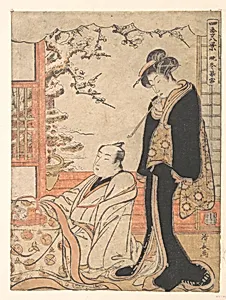
Evening Snow at Banto
ca. 1779
Medium
Woodblock print; ink and color on paper
Dimensions
9 3/5 x 7 1/5 in. (24.4 x 18.3 cm)
Classification
Prints
Culture & Period
Japan · Edo period (1615–1868)
Department
Asian Art
Museum
Metropolitan Museum of Art, New York, NY
Credit
Rogers Fund, 1914
Accession Number
JP130
Rights
Public Domain
Tags
Art Historical Context
Torii Kiyonaga's *Evening Snow at Banto (ca. 1779) captures a serene winter moment in Edo-period Japan, a time when ukiyo-e woodblock prints flourished as affordable art for the urban masses. This intimate print depicts men and women amid snow-dusted trees, evoking the quiet beauty of a snowy evening at Banto, likely a scenic locale. Kiyonaga, a leading figure in the Torii school, mastered bijin-ga (images of beautiful women) and yakusha-e (actor portraits), blending graceful figures with naturalistic landscapes in his later works. Printed with ink and color on paper, the piece exemplifies the refined techniques of ukiyo-e, where artisans carved intricate woodblocks for vibrant, multi-layered colors and subtle gradations. At just 9 3/5 x 7 1/5 inches, it was designed for personal collections, highlighting the medium's role in democratizing art during the prosperous Edo period (1615–1868). This Rogers Fund acquisition at the Metropolitan Museum of Art showcases Kiyonaga's shift toward poetic, atmospheric scenes, offering visitors a window into Japan's "floating world" of fleeting pleasures and seasonal harmony. A timeless reminder of winter's hush.
About the Artist
Torii Kiyonaga · 1752–1815
Torii Kiyonaga, born Sekiguchi Shinsuke in 1752 in Uraga, Sagami Province, was the son of an Edo bookseller who owned tenements near a bustling fish market. At age 14 in 1765, he began his apprenticeship under Torii Kiyomitsu, the third-generation head of the prestigious Torii school of ukiyo-e, renowned for kabuki theater illustrations and signage. Adopted into the Torii family, Kiyonaga succeede...