
Ewer
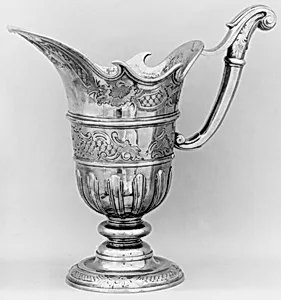
Medium
Silver gilt
Dimensions
Overall: 9 3/16 × 9 5/16 in. (23.3 × 23.7 cm)
Classification
Metalwork-Silver
Culture
Dutch, The Hague
Department
European Sculpture and Decorative Arts
Museum
Metropolitan Museum of Art, New York, NY
Credit
Frederick C. Hewitt Fund, 1911
Accession Number
11.189
Rights
Public Domain
Tags
Art Historical Context
Behold the elegant *Ewer* crafted by Dutch silversmith Christoffel Radijs 1734, a exquisite example of 18th-century metalwork from The Hague. Standing at just over 9 inches tall, this silver gilt vessel—silver coated with a thin layer of gold for a luxurious—was designed for pouring liquids, likely in a refined dining or ceremonial setting. Its compact dimensions (9 3/16 × 9 5/16 in.) made it perfect for a prosperous household's sideboard, blending functionality with opulent display. Hailing from The Hague, a hub of Dutch craftsmanship during the Dutch Golden Age's later phase, Radijs's work reflects the era's mastery of silver techniques. Gilding not only enhanced durability against tarnish but also symbolized wealth and status, with the featured coat of arms suggesting it was a bespoke commission for a prominent family. Such ewers were prized in European decorative arts, showcasing intricate chasing, engraving, and balancing form with heraldic symbolism. Acquired through the Frederick C. Hewitt Fund in 1911, this piece now graces the Metropolitan Museum of Art's European Sculpture and Decorative Arts collection. It invites visitors to appreciate how everyday objects became canvases for artistry, bridging utility and nobility in 18th-century Dutch culture.