
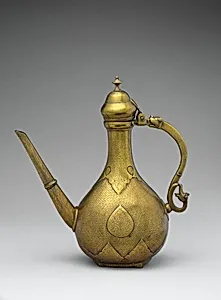
Ewer
Unknown Artist
18th–19th century
Medium
Brass; cast, cut, and chased
Dimensions
H. 12 9/16 in. (31.9 cm) W. 11 3/4 in. (29.8 cm) D. 5 5/16 in. (13.5 cm)
Classification
Metal
Department
Islamic Art
Museum
Metropolitan Museum of Art, New York, NY
Credit
Edward C. Moore Collection, Bequest of Edward C. Moore, 1891
Accession Number
91.1.582
Rights
Public Domain
Art Historical Context
This elegant brass ewer, crafted by an unknown artist in the18th–19th, exemplifies the masterful metalworking traditions of the Islamic world. Standing at 12 9/16 inches tall with a wide, flaring mouth measuring 11 3/4 inches across, it served as a practical vessel for pouring water—likely for ritual ablutions or serving in households—while doubling as a display of artistry. The medium of brass, valued for its durability and golden sheen, was cast in a mold to form the basic shape, then refined through cutting and chasing techniques. Chasing involved hammering intricate designs from the interior with specialized punches, creating raised motifs on the surface, while cutting added precise engravings, showcasing the artisan's precision and patience. In the context of Islamic art, such ewers highlight a golden age of metalwork from regions like the Ottoman Empire or Persia, where everyday objects were elevated to luxury status. These techniques allowed for complex, often floral or geometric patterns symbolizing paradise gardens or divine order, blending utility with spiritual resonance. This piece entered the Metropolitan Museum of Art through the Edward C. Moore Collection in 1891, preserving a tangible link to centuries-old craftsmanship. Step closer to admire how the chased surfaces catch the light, revealing the skill of hands long past— a testament to enduring cultural ingenuity.