
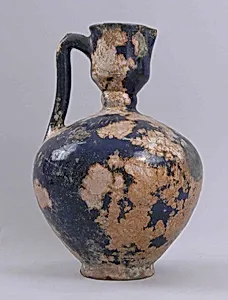
Ewer
Unknown Artist
13th–14th century
Medium
Earthenware; luster-painted
Dimensions
Ht. 11 7/16 in. (29 cm) Diam. 7 1/16 in. (18 cm)
Classification
Ceramics
Department
Islamic Art
Museum
Metropolitan Museum of Art, New York, NY
Credit
Theodore M. Davis Collection, Bequest of Theodore M. Davis, 1915
Accession Number
30.95.151
Rights
Public Domain
Art Historical Context
This elegant ewer, crafted from earthenware and adorned with luster-painting,ails from the Islamic world of the 13th–14th century. Standing at 11 7/16 inches tall with a diameter of 71/16 inches, it exemplifies the refined ceramics produced during a golden age of Islamic artistry. Ewers like this were essential vessels for pouring water, often used in of purification or at lavishquets, blending everyday utility opulent decoration. The luster-painting technique, a hallmark of Islamic ceramics, involved applying metallic oxides to the glazed surface and firing it in a reducing atmosphere to create a shimmering, iridescent glow that mimicked precious metals. Developed centuries earlier in Iraq and perfected in regions like Spain and Persia, this method showcased extraordinary technical skill and aesthetic innovation. Such pieces were prized luxury goods, traded across the Mediterranean and beyond, reflecting the cultural exchange and prosperity of medieval Islamic societies. Now part of the Theodore M. Davis Collection at The Metropolitan Museum of Art's Department of Islamic Art, this anonymous masterpiece invites us to marvel at the enduring beauty of lusterware—where clay transforms into jewel-like splendor.