
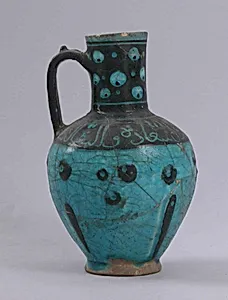
Ewer
Unknown Artist
13th century
Medium
Stonepaste; glazed
Dimensions
Ht. 7 1/2 in. (19 cm) Diam. 4 5/16 in. (11 cm)
Classification
Ceramics
Department
Islamic Art
Museum
Metropolitan Museum of Art, New York, NY
Credit
Gift of Marquis de La Bégassière, 1960
Accession Number
60.99.5
Rights
Public Domain
Art Historical Context
This elegant 13th-century ewer, crafted from stonepaste and glazed, exemplifies the ingenuity of Islamic ceramic traditions. Standing just 7½ inches tall with a diameter of 4¼ inches, it served as a practical vessel for pouring water or rosewater during daily rituals like ablutions or hospitality rites—essential in medieval Islamic culture where cleanliness and generosity were highly valued. Donated to the Metropolitan Museum of Art 1960 by the de La Bégass, it now resides in the Islamic Art department, offering a tangible link to a vibrant era of artistic innovation. Stonepaste, also known as fritware, was a revolutionary medium developed by Islamic potters around the 9th century to imitate the prized Chinese porcelain unavailable in the region. Composed of quartz, clay, and glass frit, it fired to a fine, white body that held intricate glazes beautifully, allowing for durable yet delicate forms. This technique flourished in centers like Iran and Syria during the 13th century, amid the Seljuk and Mongol-influenced periods, highlighting artisans' mastery in blending utility with subtle elegance. Though the artist remains unknown, this ewer captures the anonymous brilliance of Islamic workshops, where form and function harmonized seamlessly. Visitors, imagine filling it with scented water to welcome guests— a simple object rich in cultural poetry.