
Ewer
Unknown Artist
12th century
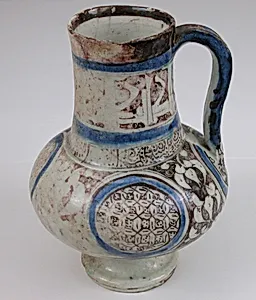
Medium
Stonepaste; painted in luster and blue on opaque white glaze under transparent colorless glaze
Dimensions
H. 7 7/16 in. (18.9 cm) Gr. Diam. 5 3/8 in. (13.7 cm)
Classification
Ceramics
Department
Islamic Art
Museum
Metropolitan Museum of Art, New York, NY
Credit
H.O. Havemeyer Collection, Gift of Horace Havemeyer, 1948
Accession Number
48.113.17
Rights
Public Domain
Art Historical Context
This elegant 12th-century e, crafted from stonepaste—a composite ceramic body developed by Islamic artisans to imitate the translucency of Chinese porcelain—stands as a testament to the ingenuity of medieval Islamic potters. Standing just over 7 inches tall with a graceful spout and flared base, it served as a practical vessel for pouring water, essential for ritual ablutions in daily life and religious practice. The ewer's surface dazzles with intricate painting in shimmering luster (a metallic oxide fired to produce an iridescent glow) and deep blue motifs over an opaque white glaze, sealed beneath a transparent colorless layer. This multi-stage glazing technique, perfected in regions like Iraq, Syria, and Iran during the Seljuk era, created luxurious, light-reflecting wares that rivaled costly metalwork. Lusterware, first innovated in the 9th century, reached artistic heights in the 12th, blending functionality with opulent decoration often featuring floral or geometric patterns symbolizing paradise gardens. Housed in the Metropolitan Museum of Art's Islamic Art collection, this ewer from the H.O. Havemeyer Collection highlights the global influence of Islamic ceramics, which inspired European artisans centuries later. It invites visitors to appreciate how everyday objects embodied cultural sophistication and technical mastery.