
Ewer and basin (lavabo set)
ca. 1680–85
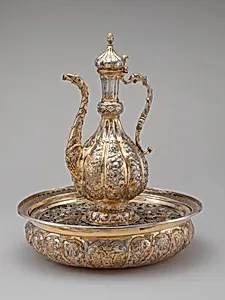
Medium
Silver, partially gilded
Dimensions
H.: 20 1/4 in., Diam.: 15 1/4 in., Wt.: 9.7lb. (51.4 cm, 38.7 cm, 4.4kg,)
Classification
Metalwork-Silver
Culture
Moldovan
Department
European Sculpture and Decorative Arts
Museum
Metropolitan Museum of Art, New York, NY
Credit
Wrightsman Fund, 2005
Accession Number
2005.62.1, .2a, b
Rights
Public Domain
Art Historical Context
Step into the elegance of 17th-century Moldovan court life with this stunning ewer and basin, known as a lavabo set crafted by the Chisinau Court Workshop around 1680–85. Designed for ritual handwashing, these vessels were essential in noble households or ecclesiastical settings, where cleanliness symbolized refinement and piety. The ewer stands an impressive 20¼ inches tall, paired with a 15¼-diameter basin, their substantial 9.7-pound weight underscoring their luxurious presence. Fashioned from silver and partially gilded, the set exemplifies masterful metalwork from Eastern Europe's Principality of Moldavia. The Chisinau workshop, likely serving the local nobility, produced such pieces amid a blend of Orthodox Christian traditions and regional influences. Gilding—achieved through techniques like fire-gilding—added a radiant glow, highlighting chased and engraved details that would have caught the light in candlelit halls. Housed in the Metropolitan Museum of Art's European Sculpture and Decorative Arts department, this rare survivor (acquired via the Wrightsman Fund in 2005) offers a glimpse into Moldovan silversmithing's artistry and status. It reminds us how everyday rituals were elevated to treasures, bridging utility and splendor in a vibrant cultural crossroads.