
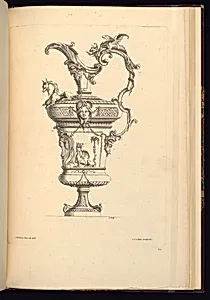
Ewer Design
early 18th century
Medium
Classification
Department
Smithsonian Collection
Museum
Smithsonian American Art Museum
Credit
Purchased for the Museum by the Advisory Council
Accession Number
1921-6-411-40
Rights
Public Domain
About this artwork
Research in Progress
Art Historical Context
This elegant print, titled Ewer Design, was created by French artist Jean-Bernard Turreau (1672–1731 in the early 18th century. As a work on paper, it captures an ornate vessel form—likely intended as a model for silversmiths, potters, or other craftsmen. Prints of this kind played a vital role in spreading decorative ideas across workshops and courts, allowing intricate designs to travel far beyond a single artist's studio. Turreau worked during a dynamic moment in French art, when the grandeur of the late Baroque was evolving toward the lighter, more fluid Rococo style. Ewers, with their sculptural handles and flowing silhouettes, were popular luxury objects that blended function with display. Though research on this specific sheet remains in progress, the print itself offers a window into the collaborative world of design, where drawing, engraving, and three-dimensional craftsmanship met. Acquired for the Smithsonian American Art Museum by its Advisory Council, the work reminds us how prints served as both artistic records and practical tools. Visitors can imagine the skilled hands that might have translated Turreau’s vision into gleaming metal or porcelain, connecting the page to the palaces and tables of early 18th-century Europe.