
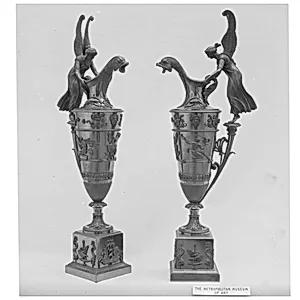
Ewer (one of a pair)
early 19th century
Medium
Gilt bronze
Dimensions
Height (each): 32 1/2 in. (82.6 cm)
Classification
Metalwork-Gilt Bronze
Culture
French
Department
European Sculpture and Decorative Arts
Museum
Metropolitan Museum of Art, New York, NY
Credit
Rogers Fund, 1919
Accession Number
19.182.4
Rights
Public Domain
Art Historical Context
This magnificent pair of gilt bronze ewers, crafted by the esteemed French sculptor and goldsmith Jean-Baptiste-Claude Oot in the early th century, exemplifies theulent Empire style that defined Napoleonic France. Standing at an impressive 32½ inches tall, these vessels were designed not just for practical use—such as pouring water or wine—but as grand decorative statements for the elite interiors of the era. Odiot, who supplied works for Napoleon and later Louis XVIII, masterfully blended neoclassical motifs inspired by ancient Greece and Rome with imperial symbolism, creating objects that radiated power and refinement. Gilt bronze, the medium here, was a hallmark of luxury metalwork during this period. Odiot's technique involved casting intricate bronze forms, then applying a thin layer of gold through mercury gilding or electroplating precursors, yielding a shimmering, durable finish that mimicked solid gold at a fraction of the cost. The ewers' elaborate chasing and chasing techniques highlight Odiot's virtuosity, with swirling acanthus leaves, mythological figures, and anthemion borders evoking the grandeur of antiquity revived for modern monarchs. Acquired through the Rogers Fund in 1919, these ewers now grace the Metropolitan Museum of Art's European Sculpture and Decorative Arts collection, offering visitors a tangible link to France's transformative early 1800s—a time when art served both aesthetics and propaganda. Pause to admire their symmetry as a pair, a nod to the balanced harmony prized in Empire design.
About the Artist
Jean-Baptiste-Claude Odiot (French) · 1763 –1850
French, 1763–1850